Distilled Water Oman: Battery Grade Supply for Ship and Forklift Batteries in Sohar
October 28, 2026
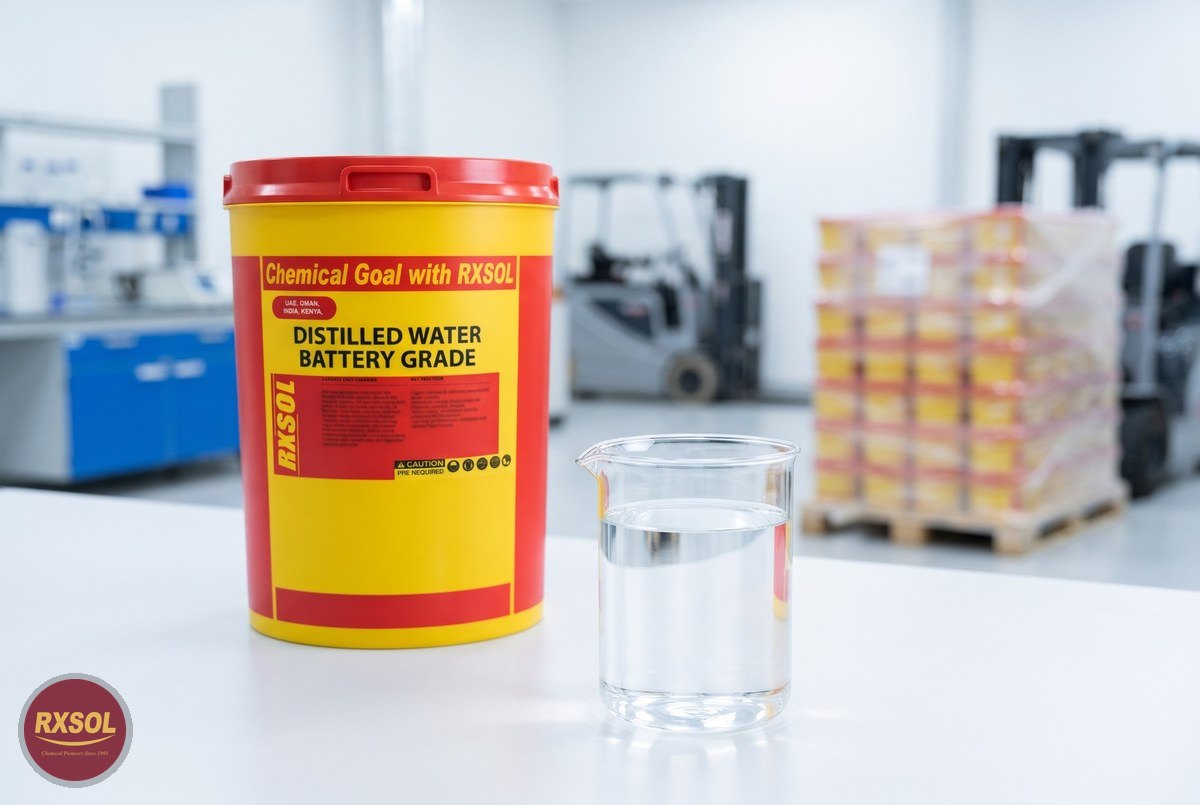
If the forklifts at your Sohar plant or the battery room on a vessel at Sohar port keep losing electrolyte, the cells need battery grade distilled water. Tap water will damage them. We supply distilled water in Oman from our Barka warehouse to Sohar and Al Batinah. It is made to the standards listed in our product record and suits topping up lead-acid and nickel-cadmium batteries.
Flooded lead-acid batteries lose water every time they charge. If the electrolyte level drops too low, the battery will be damaged, so the cells need regular topping up with distilled or demineralised water. The quality of the water matters as much as how often you add it.
What battery grade distilled water is
Distilled water is made by boiling water and condensing the steam. Salts, minerals and most other impurities stay behind, which leaves a very low mineral content. Our battery grade distilled water (RXSOL-15-1104-025) is for topping up inverter batteries and all other types of battery. You can also add it to radiator coolant at the ratio the coolant maker recommends. For general use, including windscreen washer tanks, we also stock general purpose distilled water (RXSOL-15-1104-005).
Deionised water (also spelled deionized) is made with ion-exchange resins. These remove ions but can leave organic impurities or microbes behind. Demineralised water is made by ion exchange or membranes. Distilled, deionized and demineralised water are generally all accepted for topping up batteries. The purity of the water counts for more than the name on the can.
Typical specifications: conductivity, pH and hardness
Indian Standard IS 1069:2021 covers water for lead-acid storage batteries. It sets pH 6.5 to 7.5 and a maximum conductivity of 0.5 µS/cm at 25 °C. The 2021 revision deleted the separate chloride, iron, heavy-metal and TDS limits. Guidance from battery makers is wider, with a typical target of pH about 5 to 7 and conductivity below about 10 µS/cm. Where the two differ, work to the stricter figure or to the one in your battery maker's manual.
Our product record lists the standards we supply to: IS 1069, 1070 and 7029, ISO 3696 grade 1, 2 and 3, and ASTM D-1193 grade and types 1, 2, 3 and 4. When you ask for a quote, tell us which standard your battery maker or plant specification calls for.
| Item | Detail |
|---|---|
| Part numbers | RXSOL-15-1104-025 (battery grade), RXSOL-15-1104-005 and RXSOL-15-1104-026 (distilled water) |
| Application | Top up for inverter and all types of batteries; add with coolant in radiator (as per ratio recommended); windscreen washer tank |
| Standards (our record) | IS 1069, 1070, 7029; ISO 3696 grade 1, 2, 3; ASTM D-1193 grade and types 1, 2, 3, 4 |
| IS 1069:2021 limits | pH 6.5 to 7.5; conductivity max 0.5 µS/cm at 25 °C |
| Typical values for this product class | Clear liquid; density about 0.995 to 1.0 g/cm³; pH about 7; conductivity about 2 to 3 µS/cm; silica about 0.003 mg/L; hardness under 1 mg/L as CaCO3 |
| Dosage (maintenance) | Weekly: check electrolyte level of all cells and if required, top up with battery grade water conforming to IS 1069 |
| Packing | Various quantities to order; confirm size when you request a quote |
Why tap, bottled or softened water damages batteries
Tap water adds calcium, magnesium and chloride ions. These plate onto the electrodes, speed up sulfation, raise internal resistance and cut cycle life. Calcium from hard water also increases shedding of material from the positive plates. Filtered drinking water still holds enough dissolved solids to do the same harm, and softened water is even worse than tap water.
Much of Oman's supply comes from desalination. Water that comes straight out of a desalination plant is not fit to drink and must be re-mineralised before it is used as drinking water. That means the tap in your workshop delivers water with minerals added back in. With proper distilled or demineralised water, a battery typically lasts around 5 to 6 years.
Forklift batteries in Sohar industrial zone plants
Forklifts and reach trucks at the steel, aluminium, refinery, petrochemical and logistics sites in Sohar mostly run on flooded lead-acid batteries. A forklift battery in daily use typically needs water about once a week, and heat speeds up water loss. In a Sohar summer, check levels at each charge and do not leave it to the weekly round.
Add water after charging, when the battery is fully charged. Filling before charging causes overflow and acid loss. The exception is when plates are already exposed: add only enough water to cover them, charge, then top up. Fill to about 6 mm (1/4 inch) below the bottom of the vent well, and never add sulfuric acid. If the electrolyte does not cover the plates by about 5 mm when you check at charging, top up.
Larger fleets save time with single-point watering systems, auto-shutoff watering guns and gravity-feed tanks, which cut watering time substantially compared with hand filling. UPS and standby battery rooms in the same plants follow the same rules and use the same water.
Ship battery rooms at Sohar port
On ships, battery-room cells are topped up with distilled water to the marked level after charging. Nickel-cadmium (alkaline) batteries also need distilled or deionised water. Use plastic jugs, not metal ones, together with insulated tools. Our maintenance notes say the same thing: never use metal vessels for topping up.
Ship agents and chandlers at Sohar port can add battery water for emergency-generator and battery-room banks to the rest of the vessel's stores order. When you ask for a quote, give us the vessel name, berth and agent, and we will confirm how the delivery from Barka will reach you.
Storage, mix-ups and battery-room safety
Store the water in sealed HDPE containers in a cool, dry place away from acids, bases and oxidisers. In Oman, that means a shaded store and not an open yard. Once a container is open, the water picks up CO2 from the air, which can lower its pH, so close cans after each use.
Distilled water, demineralised water, tap water and diesel exhaust fluid all look the same. Forklift batteries have been filled with urea solution by mistake, which has destroyed the batteries of whole fleets and can release ammonia. Keep battery water on its own shelf with a clear label. To check an incoming lot on site, use a pH strip, and use a handheld conductivity meter to confirm it is within your battery maker's limit.
The water itself is not GHS-classified as hazardous. The danger comes from the battery. Charging releases hydrogen, which is explosive, so battery rooms need ventilation and no naked flames. The electrolyte is corrosive sulfuric acid, so wear goggles, gloves and a face shield. If acid gets in to the eyes wash well with plenty of clean water and get immediate medical attention.
Where to buy distilled water in Oman: Sohar and Al Batinah
Sohar Chemical (RXSOL group, Oman) supplies from our Barka warehouse, with deliveries to Sohar and Al Batinah. Call +968 99489269 or message us on WhatsApp at +968 99489269. We pack in various quantities to order. Across the industry, typical sizes run from 1 L bottles and 4 to 5 L jugs, through 20 L pails and drums of about 200 L, up to IBCs of about 1000 to 1250 L. Tell us the size you need and we will confirm what we can supply.
Our sister site lists the same water as distilled water for Muscat and Ghala deliveries, and the Salalah site lists battery grade distilled water for Salalah port vessels. For other consumables for the deck, cabin and galley, get in touch through our contact page.
Frequently asked questions
Can I use tap water or bottled drinking water in a forklift or ship battery?
No. Tap water adds calcium, magnesium and chloride ions, which plate onto the electrodes and shorten battery life. Filtered drinking water still holds enough dissolved solids to do this, and softened water is worse than tap water.
What is the difference between distilled, deionised and demineralised water for batteries?
Distilled water is boiled and condensed. Deionised water passes through ion-exchange resins, which can leave organics or microbes. Demineralised water is made by ion exchange or membranes. All three are generally accepted for topping up batteries.
What conductivity and pH should battery-grade distilled water have?
IS 1069:2021 sets pH 6.5 to 7.5 and a maximum conductivity of 0.5 µS/cm at 25 °C. Battery-maker guidance typically allows pH about 5 to 7 and conductivity below about 10 µS/cm. Follow your battery maker's figure.
Should I add water to a lead-acid battery before or after charging?
After charging, when the battery is full. Filling before charging causes overflow and acid loss. If plates are already exposed, add just enough to cover them before charging, then top up afterwards.
Is battery distilled water hazardous or regulated for transport?
Battery-grade distilled water is not GHS-classified as hazardous and is not a regulated dangerous good for transport. The hazards when topping up come from the battery: hydrogen gas and sulfuric acid.
To order distilled water for your Sohar plant or vessel, request a quote or send the battery type, quantity and delivery site on WhatsApp to +968 99489269.
Frequently asked questions
Can I use tap water or bottled drinking water in a forklift or ship battery?
No. Tap water adds calcium, magnesium and chloride ions, which plate onto the electrodes and shorten battery life. Filtered drinking water still holds enough dissolved solids to do this, and softened water is worse than tap water.
What is the difference between distilled, deionised and demineralised water for batteries?
Distilled water is boiled and condensed. Deionised water passes through ion-exchange resins, which can leave organics or microbes. Demineralised water is made by ion exchange or membranes. All three are generally accepted for topping up batteries.
What conductivity and pH should battery-grade distilled water have?
IS 1069:2021 sets pH 6.5 to 7.5 and a maximum conductivity of 0.5 µS/cm at 25 °C. Battery-maker guidance typically allows pH about 5 to 7 and conductivity below about 10 µS/cm. Follow your battery maker's figure.
Should I add water to a lead-acid battery before or after charging?
After charging, when the battery is full. Filling before charging causes overflow and acid loss. If plates are already exposed, add just enough to cover them before charging, then top up afterwards.
Is battery distilled water hazardous or regulated for transport?
Battery-grade distilled water is not GHS-classified as hazardous and is not a regulated dangerous good for transport. The hazards when topping up come from the battery: hydrogen gas and sulfuric acid.
