Marine Descaler Supplier Oman: Galley and Freshwater Lines at Sohar Port
November 05, 2026
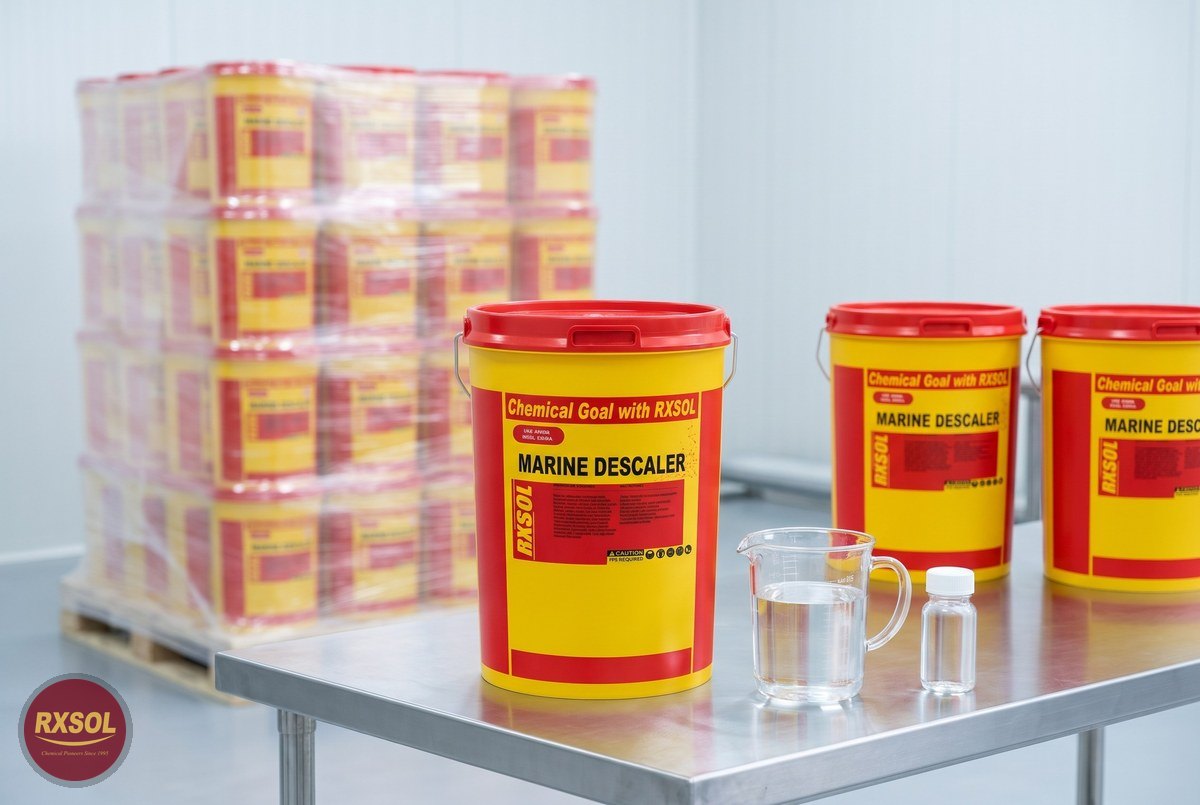
Hard water scale in a ship's galley kettle, dishwasher or calorifier slows heating and chokes flow, and a marine descaler dissolves it without dismantling the equipment. Sohar Chemical is a marine descaler supplier Oman ship operators can order from for delivery to Sohar Port. Our biodegradable Marine Descaler (part number RXSOL-25-1747-025) is held at our Barka warehouse. The method is short: circulate or soak the descaler at ambient temperature, flush with fresh water, check the pH, and put the system back in service.
What a marine descaler does and why scale builds fast at Sohar
A marine descaler is typically a liquid acid blend with descaling accelerators, corrosion inhibitors and wetting agents. It dissolves calcium carbonate scale, rust and salt deposits so they rinse away with water. Our Marine Descaler for galley and water systems is a biodegradable formulation. It is made to dissolve calcium, rust, mussels, barnacles, tiger shells and other water formed mineral deposits that reduce the performance of vessel water systems.
Scale forms when hardness salts come out of heated water. Calcium carbonate becomes less soluble as water gets hotter, so the hottest surfaces on board scale first: calorifier coils, kettle elements, dishwasher booster heaters and fresh water generator tubes. On Gulf routes the ambient temperature is high, and fresh water is taken on at ports where the hardness varies. As a result, galley and freshwater equipment on vessels calling at Sohar often needs descaling sooner than the same equipment in cooler waters.
Galley equipment, calorifiers and freshwater lines you can descale
In the galley, the usual targets are dishwashers and hot water urns. Small removable parts such as spray arms, nozzles and strainers can soak in an immersion bath. Larger equipment and pipework are cleaned by circulating the solution with a pump.
For food-service equipment, typical practice with this product class is to dilute with up to 20 parts water for dishwashers and circulate until the scale is removed. Tea urns typically need about 1 hour of contact. Do not use it on aluminium or Teflon-coated items.
In the engine room and accommodation, the same class of descaler is used on fresh water generators and evaporators, heat exchangers, condensers, chillers, boilers, water pumps, A/C and refrigeration systems and sea strainers. Our product data also covers vessels that are heat exchanger cooled, keel cooled or radiator cooled. Where auxiliary coolers are fitted, the solution can dissolve deposits in some equipment while it is running, with no shutdown.
For degreasers and cleaners to use alongside a descaling job, see our deck, cabin and galley maintenance chemicals.
Metals, dilution and contact time
Our product data lists no corroding, eroding or oxidising effect on brass, iron, copper, steel, titanium, copper nickel, rubber, glass, fibreglass, plastics, ceramic, wood, leather, gelcoats and painted surfaces. Across the product class, inhibited descalers are generally safe on copper, copper-nickel, bronze, brass, iron, steel and stainless steel. Many acid descalers attack aluminium, zinc, tin, galvanised surfaces and some stainless alloys. On those metals, use a weaker solution for a short time or do not use it at all. Replace sacrificial anodes after descaling.
The descaler is an electrolyte, as are most cleaning agents. In mixed-metal circuits it may cause light plating, for example a thin coating of copper on a steel drum. Tell us the metals in your system before you start.
The right dilution depends on how heavy the scale is. Typical figures for liquid descalers are 5 to 30% in fresh water. Small-craft concentrates are often used at 1 part descaler to 4 parts fresh water, recirculated or soaked for 4 to 8 hours. Biodegradable bio-descalers are often used at a 1:1 dilution, and the fizzing reaction is usually complete in 1 to 4 hours. Heavy hardness scale can need 24 to 36 hours of circulation at 10 to 20% solution. These are class figures, so confirm the ratio for your system against the SDS and TDS before use.
Our grade can be used at any temperature within the operating limits between 0°F / -18°C and 180°F / 82°C, and needs no heating. The solution is exothermic but does not develop a substantial increase in temperature while dissolving scale. If it freezes, slushes or thickens at low temperature and then thaws, its performance is not reduced. Above 180°F, consult us before use.
| Item | Detail |
|---|---|
| Part number | RXSOL-25-1747-025 (galley maintenance), RXSOL-25-1747-210 (scale remover) |
| Application | Calcium, rust, mussels, barnacles, tiger shells and other water formed mineral deposits in marine water systems |
| Operating temperature | 0°F / -18°C to 180°F / 82°C, applied at ambient temperature, no heating required |
| Dilution | Typical for the product class: 5 to 30% in fresh water depending on scale, confirm against the SDS and TDS |
| Physical state | Liquid, dark liquid |
| Boiling point | 105° C |
| Solubility in water | Miscible |
| Specific gravity (water=1) | 1.03 @ 25 DEGREE C |
| Vapour pressure | 20.1mmHg @ 25 DEGREE C |
| Vapour density (air=1) | .62 @ 25 DEGREE C |
| pH | Unreadable, generally < 3 |
| Evaporation rate (water=1) | Slow |
| Shelf life | Does not deteriorate or lose effectiveness for at least five years |
Step by step: circulation descaling and return to potable service
- Isolate and drain the system and flush out any seawater. If oil, grease or sludge is present, pre-clean with a degreaser.
- Mix the solution in a plastic container. Always add the acid to the water, never the water to the acid.
- Circulate the diluted descaler with a pump. Do not seal the system, because gassing builds pressure.
- Slight foaming or bubbling shows the deposits are dissolving. Monitor pH during circulation and add more product if pH rises above about 3. When the foaming stops and the pH holds steady, the scale has dissolved.
- Drain and flush with fresh water until pH is above 6. Our grade is free rinsing and, according to our product data, does not need a neutraliser. With strong acid descalers, the usual practice is to circulate about 0.5 to 2% alkaline neutraliser for 2 to 6 hours until pH reaches 6 to 7.
- Reconnect, refill and check for leaks before returning the equipment to service.
For potable water lines, calorifiers and hydrophore tanks, flushing to a neutral pH is the minimum. Before the system goes back into drinking-water service, disinfect and sample it under your vessel's potable water management plan and keep the record. Read the SDS and TDS before using any descaler on a drinking-water circuit.
Safety, gas release and spent solution
Our product data describes the formulation as non-corrosive, non-hazardous and biodegradable. In rare cases, problem vapours can occur where there are high concentrations of sulphur or chlorine, so contact us before descaling such a system. Its pH is generally < 3, so handle it with the same care as any acid product. Acid descalers as a class can cause irritation or burns to skin, eyes and the respiratory tract and may be harmful if swallowed. Avoid breathing mists.
Wear gloves and goggles, plus an apron and boots where splashes are possible. Rinse eye contact with plenty of water. Descaling reactions can release gases such as carbon dioxide and hydrogen. Check the atmosphere with gas detection before anyone enters a tank or confined space after descaling.
Dispose of the spent solution in line with local regulations. Some biodegradable grades can go to the sewer once the system has been flushed until pH is above 6. At Sohar Port, arrange disposal through your ship agent and do not discharge it overboard.
Marine descaler supplier Oman: delivery to Sohar Port from Barka
Sohar Chemical (RXSOL group, Oman) holds the Marine Descaler at our Barka warehouse and delivers to Sohar and Al Batinah. That includes vessels at Sohar Port. The same product is listed in our scale remover range under part number RXSOL-25-1747-210.
If your vessel calls at Muscat first, the descaler is also stocked for marine descaler deliveries in Muscat. For calls in Dhofar, it is available for deliveries at Salalah port.
Call +968 99489269 or send us a WhatsApp message with the vessel name, the berth or agent, the equipment and the approximate system volume. Read the SDS and TDS before the product goes on board.
Frequently asked questions
Is marine descaler safe on copper, brass, stainless steel and aluminium?
Our product data lists no harmful effect on brass, copper, copper nickel, steel and titanium. Inhibited descalers are generally safe on stainless steel. Many acid descalers attack aluminium, zinc and galvanised surfaces, so on those metals use a weaker solution for a short time or do not use it at all.
What dilution ratio and circulation time should I use?
Typical figures for this class of product are 5 to 30% in fresh water. Bio-descalers usually finish reacting in 1 to 4 hours, while heavy hardness scale can need 24 to 36 hours. Stop when the foaming ends and the pH holds steady, then flush until pH is above 6.
Can descaler be used on potable water systems on board?
Check the SDS and TDS first, and use the descaler on a drinking-water circuit only if they allow it. After descaling, flush with fresh water until the pH is neutral. Then disinfect and sample the system under your vessel's potable water plan before it goes back into drinking-water service.
How often should ship galley equipment be descaled in hard-water areas?
Typical food-service practice is to descale every 3 months in hard-water areas and every 6 months in soft-water areas.
Where can I buy marine descaler in Oman for delivery to Sohar Port?
Order from Sohar Chemical. We deliver from our Barka warehouse to Sohar Port and Al Batinah. Call or WhatsApp +968 99489269.
To order, request a quote for marine descaler or send us your requirement on WhatsApp at +968 99489269.
Frequently asked questions
Is marine descaler safe on copper, brass, stainless steel and aluminium?
Our product data lists no harmful effect on brass, copper, copper nickel, steel and titanium. Inhibited descalers are generally safe on stainless steel. Many acid descalers attack aluminium, zinc and galvanised surfaces, so on those metals use a weaker solution for a short time or do not use it at all.
What dilution ratio and circulation time should I use?
Typical figures for this class of product are 5 to 30% in fresh water. Bio-descalers usually finish reacting in 1 to 4 hours, while heavy hardness scale can need 24 to 36 hours. Stop when the foaming ends and the pH holds steady, then flush until pH is above 6.
Can descaler be used on potable water systems on board?
Check the SDS and TDS first, and use the descaler on a drinking-water circuit only if they allow it. After descaling, flush with fresh water until the pH is neutral. Then disinfect and sample the system under your vessel's potable water plan before it goes back into drinking-water service.
How often should ship galley equipment be descaled in hard-water areas?
Typical food-service practice is to descale every 3 months in hard-water areas and every 6 months in soft-water areas.
Where can I buy marine descaler in Oman for delivery to Sohar Port?
Order from Sohar Chemical. We deliver from our Barka warehouse to Sohar Port and Al Batinah. Call or WhatsApp +968 99489269.
