
Separator Disc Cleaner for Ship Purifiers at Sohar Port
November 10, 2026
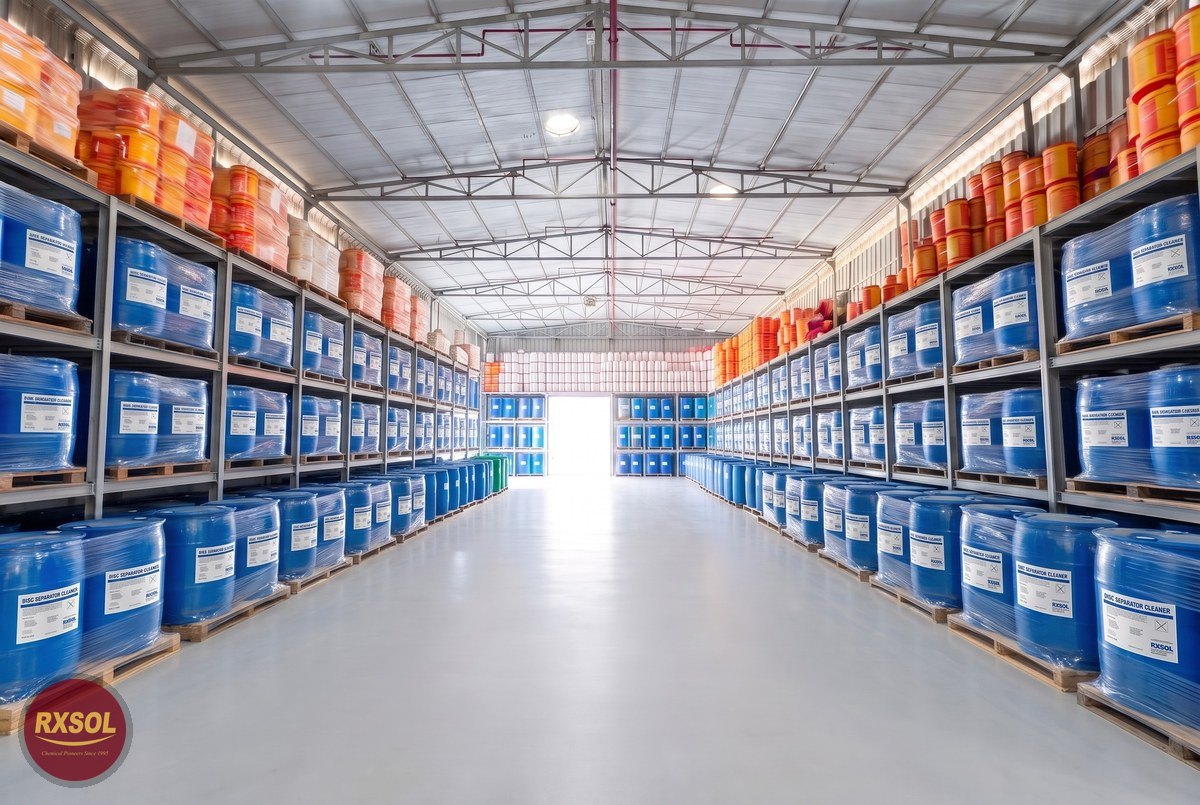
If your fuel oil purifier starts sending water into the clean oil, or vibrates after a long run, the disc stack is usually fouled. A separator disc cleaner is the fastest way to get it working again. We supply acidic separator disc cleaner from our Barka warehouse to vessels calling at Sohar Port and to plants in Sohar Industrial Zone. You soak the stainless steel discs in the diluted or neat product and rinse them with fresh water. The purifier then goes back into service without any scrubbing.
What a separator disc cleaner removes and why discs foul
A separator disc cleaner is a cleaning chemical made for the stainless steel discs and bowls of centrifugal fuel oil and lube oil separators and purifiers. A clean disc stack keeps separation efficiency up, so cleaner oil reaches the engine.
Most of the deposit on separator discs is hardness salts such as calcium carbonate. The rest is partly carbonised oil, burnt grease, lacquers and oily residue. On ships trading in the Gulf, hot engine rooms and heavy residual fuels add to the carbon load. Any hard water or seawater carried in with the oil leaves calcium salts on the discs. A plain degreaser lifts the oil but leaves the scale behind, so products of this class do both jobs.
Products of this type are typically a blend of inhibited acids, surfactants and emulsifying agents, and some also contain an organic solvent. Our Disc Separator Cleaner RXSOL-16-1007-025 is a liquid blend of organic solvent with concentrated acidic emulsifying agents, developed for stainless steel separator and purifier discs. The acid dissolves calcium carbonate salt deposits, and the solvent and emulsifiers remove burnt grease, carbon and lacquers. It cleans down to the metal surface and leaves no film or residue. Our data sheet also lists passivating spare parts and pickling iron and steel surfaces after a welding repair as further uses.
Open and clean the bowl when you see too much sludge, poor oil purification, vibration, water in the clean oil, or long running without inspection. The right interval depends on the oil type and your operating conditions, so follow the purifier maker's schedule and treat these signs as the trigger. Each time the bowl is open, use the chemical instead of a brush. Scrubbing and brushing damage the discs, and damaged discs separate poorly.
Specification and part numbers
The table combines our product records with typical values for acidic disc cleaners.
| Item | Detail |
|---|---|
| Part numbers | RXSOL-16-1007-025 Disc Separator Cleaner; RXSOL-16-1007-020 Disc Separator Clean; RXSOL-16-1007-210 Separator Disc Cleaner; RXSOL-16-1046-020 and RXSOL-16-1046-210 Disc Separator Cleaner HD |
| Type | RXSOL-16-1007-025: colourless, strong acid liquid cleaning agent with strong degreasing properties. HD grades: heavy duty liquid blend of organic solvent with concentrated emulsifying agents |
| Application | Heavy tenacious deposits in fuel and lube oil centrifugal separator disc stacks, purifiers and filters |
| General dilution | 1 part cleaner to 5 parts water, or 1:1 with a solvent such as diesel, depending on the nature of the dirt |
| Heavy deposits | Concentrated product, 15 minutes to 3 hours at 50 to 60°C (heating is not necessary) |
| Specific gravity (20°C) | 1.03 to 1.04 |
| pH (1% solution) | < 2 |
| Flash point | None |
| IMO code | 8-2031-T700 |
| Metals (RXSOL-16-1007-025) | Austenitic stainless steel only; corrosive on all other metals |
| Packing | Confirmed for each part number on your quote |
| MSDS | On request |
For very heavy carbon and burnt grease, the Disc Separator Cleaner HD RXSOL-16-1046-020 uses the same dilution and soak method.
Dilution, soak time and temperature by deposit type
Below, our data sheet values sit next to typical values for this class of product. Start with the weaker mix and go stronger only if deposits remain.
- Light oil film and general cleaning: our data sheet gives 1 part RXSOL-16-1007-025 to 5 parts water. Products of this class typically soak for 30 minutes up to about 2 hours.
- Carbon, burnt grease and sludge: a stronger mix of 1 part cleaner to 3 parts fresh water is typical for the class. Typical soak times are 2 to 4 hours, or overnight if needed. For oily deposits our data sheet also allows a 1:1 ratio with a solvent such as diesel.
- Heavy calcium scale and tenacious deposits: immerse the stainless steel discs in concentrated RXSOL-16-1007-025 for 15 minutes to 3 hours at 50 to 60°C. Heating is not necessary, but recirculation and heating improve the cleaning action. Typical guidance for the class is a maximum of about 60°C.
A higher concentration cleans faster, so check a disc at intervals and stop once it is down to bare metal.
Step by step: cleaning a purifier disc stack on board
- Stop the purifier, isolate the power and wait until the bowl has stopped turning completely.
- Remove the hood with the lifting tool, then lift out the distributor and disc stack. Keep the discs in their original order.
- Make up the solution in a stainless steel or plastic container. Leave space between the discs so the liquid reaches every surface. Our grades can clean the discs without dismantling the disc stack, which saves downtime on a short port call.
- Soak at the strength and time for your deposit type. If you can, heat to 50 to 60°C and circulate the solution. If there is no soaking tank, spray the discs instead.
- Lift the discs out wearing rubber gloves and rinse thoroughly with fresh water. A powerful water jet helps remove all traces of deposit and cleaner. The discs can then go straight back into service.
- Inspect each disc for cracks, corrosion and blocked passages, and replace the O-rings.
- Reassemble in sequence, torque the lock ring and test run without oil feed. Discs fitted out of sequence cause poor separation and vibration.
Materials, safety, storage and disposal
RXSOL-16-1007-025 is for austenitic stainless steel only and corrodes all other metals. Do not use any of our disc cleaner grades on soft metal, zinc, tin, galvanised surfaces or anodised aluminium. Typical guidance for acidic cleaners also lists mild steel, cast iron, aluminium alloys and brass. Take brass fittings, aluminium parts and any galvanised trays out of the bath before you soak the discs.
The product carries R 36: Irritating to eyes and skin. S 2: Keep out of reach of children. S 28: After contact with skin rinse immediately with plenty of water. Wear gloves, goggles and protective clothing, and keep the purifier room well ventilated.
Keep the container tightly closed to avoid contamination, and read the MSDS before you use the product. Dispose of spent solution in line with local regulations.
Where to buy separator disc cleaner in Sohar
Sohar Chemical (RXSOL group, Oman) supplies separator disc cleaner from our Barka warehouse and delivers to Sohar and Al Batinah. Ship agents and chandlers at Sohar Port can send us the vessel name, part number and quantity, and we confirm the pack size and delivery. Call +968 99489269 or message us on WhatsApp.
The same cleaning method works in shore plants. Disc-stack centrifuges in Sohar Industrial Zone foul with the same carbon and scale. These include refinery, petrochemical, aluminium and steel mill lube oil systems, and power and desalination plants. For planned plant overhauls, the Disc Separator Cleaner HD RXSOL-16-1046-210 is listed on its product page as a 210 litre pack. Our full range of marine and industrial chemicals also covers the degreasers and descalers you may need during the same shutdown.
If your vessel calls at Muscat instead, the same grade is listed under Disc Separator Cleaner for Muscat deliveries. For ships working the south coast, the HD grade is listed under Disc Separator Cleaner HD for Salalah port supply.
Frequently asked questions
What chemical is used to clean purifier discs?
Purifier discs are cleaned with an acidic separator disc cleaner. This is a blend of inhibited acids, surfactants and emulsifying agents, and some grades also contain an organic solvent. It dissolves calcium carbonate scale and removes carbon, burnt grease and lacquers without brushing.
What is the dilution ratio for a separator disc cleaner?
Our data sheet gives 1 part cleaner to 5 parts water for general cleaning, or 1:1 with a solvent such as diesel. Products of this class are typically used at 1 part cleaner to 3 to 5 parts water. For heavy deposits, use the concentrated product.
How long should purifier discs soak, and can the bath be heated?
For heavy deposits, soak in the concentrated product for 15 minutes to 3 hours at 50 to 60°C. Weaker mixes typically need 30 minutes to about 2 hours, and heavy carbon may need 2 to 4 hours or overnight. Heating is not necessary, but heating and circulating the solution speed up cleaning.
Is separator disc cleaner safe on aluminium, zinc or galvanised parts?
No. RXSOL-16-1007-025 is for austenitic stainless steel only. Do not use any of our disc cleaner grades on soft metal, zinc, tin, galvanised surfaces or anodised aluminium.
Can separator discs be cleaned without dismantling the disc stack?
Yes. Our disc cleaners can clean the discs without dismantling the disc stack, which reduces downtime. Afterwards, rinse thoroughly with fresh water and the stack can go back into service.
