
Air Cooler Cleaner for Charge Air Coolers at Sohar Port
November 16, 2026
TL;DR
- Air cooler cleaner removes oil, grease and carbon deposits from the air side of diesel engine charge air coolers.
- A rising air-side pressure drop points to air-passage fouling. A rising water-side pressure drop points to scale, which needs a descaler.
- Online injection needs engine-maker approval and installed dosing equipment. Hand spraying needs the engine stopped.
- Typical online figures for this type of product: 25% in fresh water, 3 L working solution per m² of cooler cross-section. Check our TDS for the exact figure.
- Ask for ACC-009 (RXSOL-16-1049-020) or LT (RXSOL-16-1049-025) on WhatsApp +968 99489269, with delivery from Barka to Sohar.
An air cooler cleaner is a formulated cleaner, often sold as a solvent emulsion cleaner, that removes oil, grease and carbon deposits from the air side of diesel engine charge air coolers, scavenging air systems and turbocharger compressor sides. If your ship is coming into Sohar with rising scavenge air temperature and a growing pressure drop across the cooler, an air-side wash with a dedicated cleaner is usually the fix, as long as the engine maker's procedure allows it.
Air-side fouling is a separate problem from water-side scale, and the two need different chemicals. Before you order anything, confirm which side of the cooler is fouled.
What air cooler cleaner removes and why coolers foul
The cleaner breaks up the oily film on the cooler fins and tubes and loosens the solid dirt held in it, so the water rinse can carry both away. Air leaving the turbocharger carries oil, grease, sea salt, dust and other airborne dirt, and these settle on the cooler fins and tubes.
The oil film is what makes the problem grow. Once the fins are oily, soot and dust stick to them instead of passing through, and each layer narrows the air passages a little more. Salt and dust in the intake air add to the deposits.
Air-side fouling or water-side scale: how to tell
Pressure drop readings show you which side is fouled. Compare them with the engine maker's limits rather than a general figure.
| What you see | What it points to | Next step |
|---|---|---|
| Air pressure drop across the cooler rising | Fouled air passages | Air-side wash with an air cooler cleaner |
| Water-side pressure drop rising | Fouled water passages | Separate descaling procedure, then flushing and a water-space pressure test |
| Gap between air outlet temperature and cooling-water inlet temperature widening | Cooler performance falling, on either side | Check both pressure drops and the cooling-water flow before choosing a chemical |
| Exhaust temperatures up on all cylinders, scavenging pressure down | Possible air system fouling, but this does not single out the cooler | Check the intake side and turbocharger as well as the cooler |
| Scavenging pressure down while the cooler air pressure drop stays normal | Possible intake filter or silencer restriction | Inspect and clean the turbocharger intake filter or silencer before washing the cooler |
An air cooler cleaner works on the air side only; for water-side scale, ask us for a descaler.
Online washing or offline cleaning
Online washing is for routine cleaning where the engine maker allows it and dosing and injection equipment is fitted correctly. The other methods need the engine stopped, and which one you use depends on the cooler design, the downtime available and the engine maker's procedure.
| Method | Engine | Typical use | What it needs |
|---|---|---|---|
| In-service injection | Running | Routine cleaning where the engine maker allows it | Engine-maker approval, installed dosing and injection equipment, fresh water rinse |
| Hand spray through the inspection opening | Stopped | Cleaning the cooler coil in place through the inspection opening | Undiluted cleaner, at least 1 hour penetration time, drains open, fresh water rinse |
| Flooded cleaning in place | Stopped | Depends on the cooler design and the engine maker's procedure | Cooler isolated from the turbocharger and charge-air pipe with blind flanges |
| Immersion with the cooler removed | Stopped, cooler out | Depends on the downtime available and the engine maker's procedure | Typical example: undiluted cleaner at 30 °C for 2 hours, then drain, water flush and air dry |
| Circulation | Stopped | Depends on the cooler design, a circulation rig and the engine maker's procedure | Typical example: 25-30 °C for 20 hours, then fresh water flush and drying |
How to mix and apply air cooler cleaning solution
For online injection, this type of product is typically used at 25% in fresh water, at 3 L of working solution per m² of cooler cross-sectional area. Published figures for the class run from 25-33% cleaner in the working solution, and one dosing-pot dilution is 1:2 cleaner:water. Refer to our TDS for the exact figure for the part number you order.
Here is a worked example using those typical figures. Say your cooler cross-section is 2.0 m²: at 3 L per m² you need 6 L of working solution. At 25%, that is 1.5 L of concentrate made up to 6 L with fresh water. The 6 L is the final volume, so you add 4.5 L of water, not 6 L.
A typical approved online sequence:
- Confirm the engine maker allows in-service cleaning and that the dosing and injection equipment is in working order.
- Mix the working solution in fresh water to the figure on the TDS.
- Inject it upstream of the charge air cooler over 10 minutes.
- Wait 10 minutes, then inject an equal quantity of fresh rinse water.
- Drain the wash liquid into the oily or dirty-water system.
A typical offline hand-spray sequence:
- Stop the engine and open the cooler inspection opening. Wear protective clothing, gloves and eye protection, and read the SDS for the product before you start.
- Open the cooler drains and keep them open through washing and flushing so contaminated liquid can leave the cooler.
- Spray undiluted cleaner over the whole cooler coil and leave it for at least 1 hour to penetrate.
- Rinse thoroughly with fresh water until the run-off is clean, then close the drains.
- Pump the wash liquid to the designated oily or dirty-water system, following the manufacturer's disposal instructions and MARPOL requirements.
Some formulations of this type can swell rubber and synthetic rubber, so check your seals are compatible first. With a flammable cleaning agent, keep the cleaning temperature at least 10 °C below its flash point. Plan your fresh water supply and waste collection with your agent before the wash, because both affect how long the job takes alongside.
Check the result with before and after readings
A wash has worked when scavenging pressure recovers and temperatures move back towards their rated values. Take the readings at a similar engine load and cooling-water inlet temperature, otherwise you are not comparing like with like.
| Reading | Before wash | After wash |
|---|---|---|
| Engine load | ||
| Cooling-water inlet temperature | ||
| Charge air temperature, cooler outlet | ||
| Air pressure drop across the cooler | ||
| Scavenging pressure and temperature | ||
| Inspection notes on fins and drains |
Keep this sheet with your maintenance records. If the pressure drop climbs back quickly after a good wash, look for where the oil and dust are coming from on the intake side rather than washing more often.
ACC-009, LT or a general degreaser
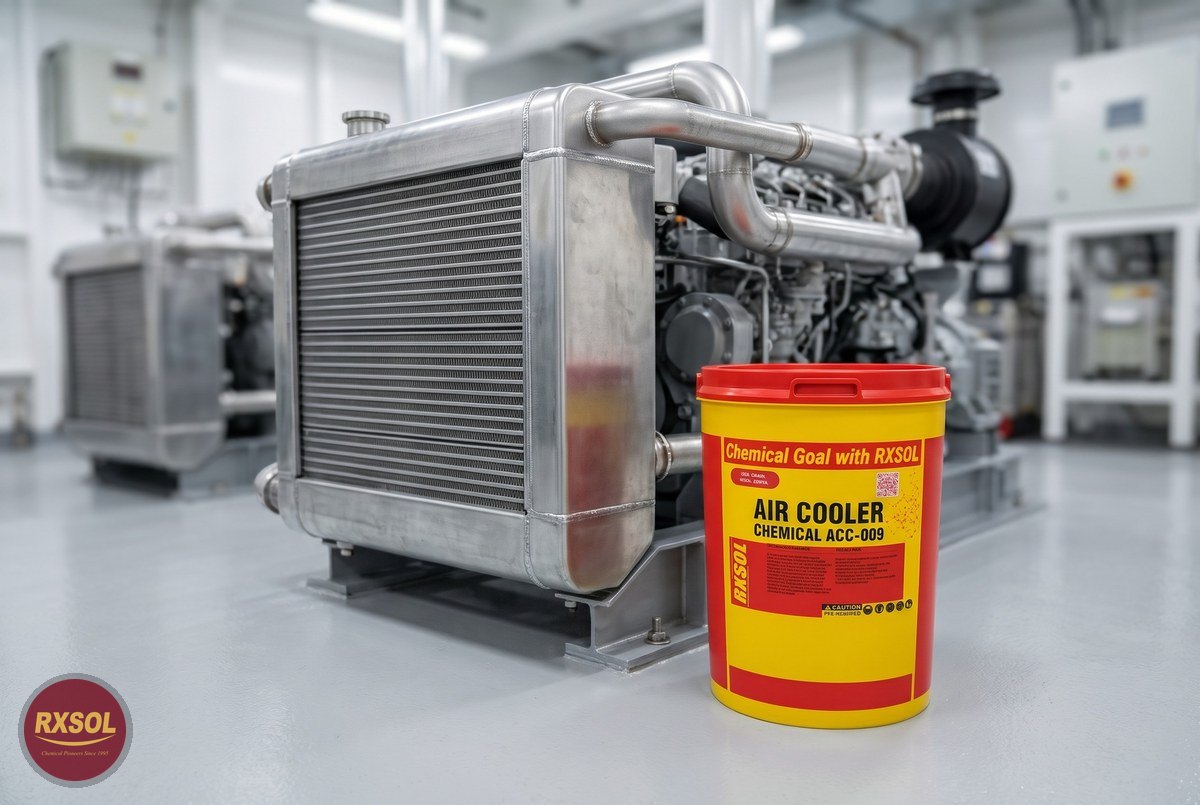
We supply two air cooler cleaners: Air Cooler Chemical ACC-009 and Air Cooler Cleaning Chemical LT. Both are listed for cleaning air coolers, scavenging air systems and turbochargers; the composition and dilution are on each product's TDS and SDS. Send us your engine and cooler details and we will match the TDS to your procedure. We do not claim a performance difference between them.
| Item | Detail |
|---|---|
| Part numbers | RXSOL-16-1049-020 (ACC-009), RXSOL-16-1049-025 (LT) |
| Application | Air side of charge air coolers, scavenging air systems, turbocharger compressor side |
| Typical online dose for this product class | 25% in fresh water, 3 L working solution per m² of cooler cross-section; exact figure on our TDS |
| Typical offline method for this product class | Undiluted hand spray, minimum 1 hour, fresh water rinse with drains open |
| Technical documents | TDS and MSDS on request |
General degreasers such as Aqua Sol Break or Heavy Duty Degreaser, found in our degreaser category, are made for engine rooms, decks and machinery. Being able to remove grease does not make a product suitable for a charge air cooler, so do not inject one online or use it on the cooler unless the engine procedure and the product's own documents allow it. For other engine room jobs, our article on degreasers in industry sets out where each type fits.
Where to buy air cooler cleaner in Sohar
Sohar Chemical (RXSOL group, Oman) delivers from our Barka warehouse to Sohar and Al Batinah. We confirm availability, quantity and the delivery window in the quotation. If the ship's next call is Muscat, the same part number is listed on our Muscat site.
So that we can quote quickly for a Sohar port call, send us:
- Vessel name, IMO number, call sign and ETA
- Berth or anchorage, vessel agent and the contact on board
- Engine and cooler model, air-side materials and the cleaning method the engine maker allows
- Deposit type, how bad the fouling is, and the cooler cross-section if you know it
- Part number, quantity, and whether you need the SDS and TDS sent with the quote
- Delivery window and any port access requirements, including dangerous-goods details if your agent asks for them
To request a quote, call or WhatsApp +968 99489269, or use our quote request page.
Need Air Cooler Chemical ACC-009? Ask us for a quote, the TDS or the MSDS. Delivery across Oman from our Barka warehouse.
Frequently asked questions
What is air cooler cleaner used for on marine diesel engines?
It removes oil, grease and carbon deposits from the air side of charge air coolers, scavenging air systems and turbocharger compressor sides, so air passes through the cooler freely and is cooled properly again.
How can engineers tell air-side fouling from water-side scale?
Check the pressure drops. A rising air-side pressure drop points to fouled air passages, which an air cooler cleaner deals with. A rising water-side pressure drop points to scale, which needs a separate descaling procedure, flushing and a water-space pressure test.
Can a charge air cooler be cleaned while the engine is running?
Yes, but only when the engine maker approves in-service cleaning and dosing and injection equipment is fitted correctly. The cleaner is injected upstream of the cooler and then rinsed through with fresh water. Hand spraying through the inspection opening needs the engine stopped.
How much air cooler cleaner should be mixed with fresh water?
For online injection, this type of product is typically used at 25% in fresh water, at 3 L of working solution per m² of cooler cross-section. For hand spraying it is typically used undiluted. Refer to our TDS for the exact figure for ACC-009 or LT.
What do you need to quote for a Sohar port call?
Send the vessel name, IMO number, call sign, ETA, berth or anchorage, vessel agent and onboard contact, plus the engine and cooler model, cleaning method allowed, part number, quantity, delivery window and any access or dangerous-goods requirements. We confirm availability and delivery from Barka in the quotation.
