Industrial Air Cooler Cleaning at Sohar Port: Scale Dissolver Guide
October 29, 2026
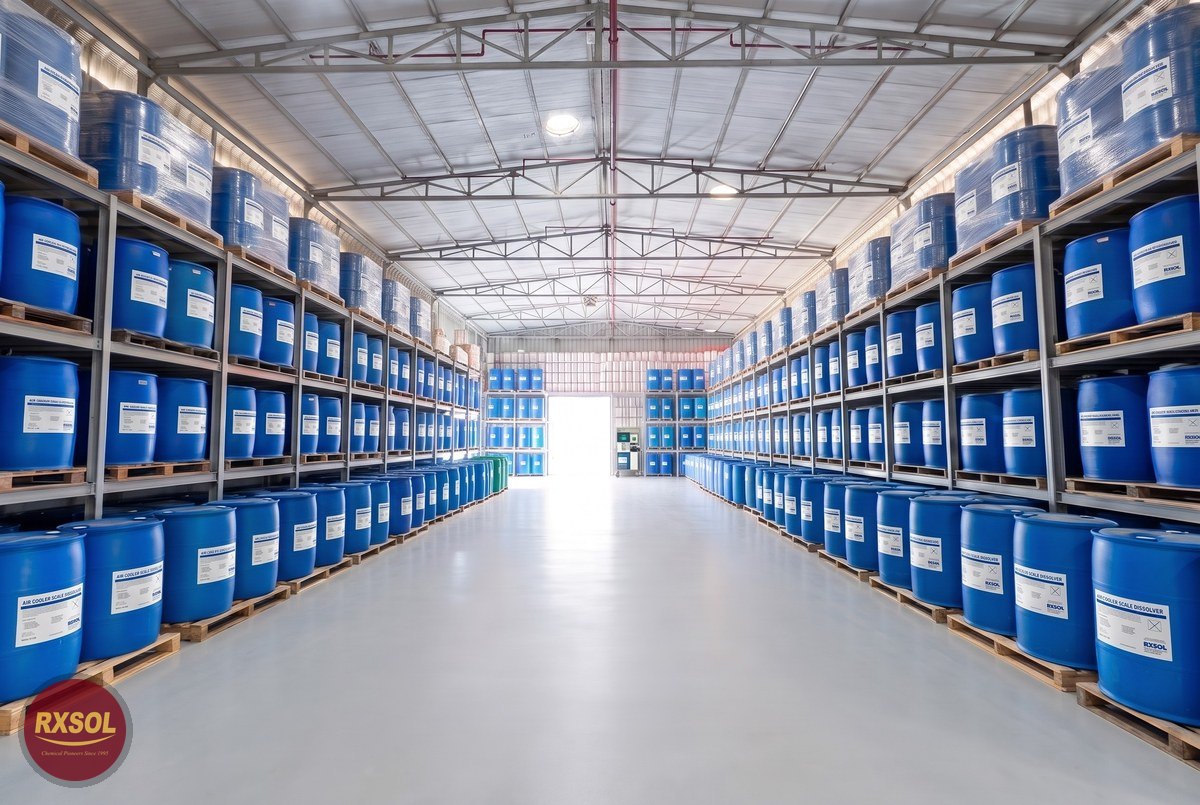
Scale on the sea water side of a charge air cooler or plant cooler cuts heat transfer, and our Air Cooler Scale Dissolver (RXSOL-54-1048-020) is the inhibited acid product we supply in Sohar to remove it. Industrial air cooler cleaning has two parts. The air side collects oil, grease and carbon and needs a solvent-emulsion cleaner. The water side collects hardness scale and needs an acid scale dissolver. For scale, our CRM guidance is an initial trial concentration of 5 to 10% product in water for light scale, 10 to 20% for moderate scale and 20 to 30% for heavy scale, subject to compatibility. You circulate the solution, check the end point, then neutralise. We deliver from our Barka warehouse to Sohar port and the Sohar industrial zone.
What industrial air cooler cleaning involves: air side and sea water side
An air cooler fouls on two surfaces, and each needs a different chemical. Air passing over the fins carries oil mist, carbon and dust, which build a greasy layer on the air side. Sea water or cooling tower water running through the tubes leaves calcium carbonate and other mineral scale on the water side.
Buyers often order the wrong product. A solvent-emulsion air cooler cleaner will not dissolve hardness scale, and an acid descaler is not the right product for an oily air side. Our Air Cooler Scale Dissolver is for the sea water side and other compatible water-side surfaces.
For the air side, the typical method for this product class out of service is to spray the cleaner on undiluted with the engine stopped and the cooler drains open, leave it to penetrate for at least 1 hour, then wash it off with a water jet and flush with fresh water. In-service air side cleaning is done only if the engine maker approves it, typically with a 25% solution in fresh water at about 3 L of solution per m² of cooler cross-section, injected upstream of the cooler over about 10 minutes and followed by a fresh water rinse. Solvent-emulsion cleaners may swell rubber and synthetic rubber seals, so check your gaskets.
Signs your cooler needs cleaning
On a marine diesel engine, a manometer across the charge air cooler shows air side fouling through a rising pressure drop. Water side scale shows up as a high charge air temperature and a smaller temperature drop across the cooler than the engine log shows when it was clean.
Charge air temperature has to stay under control. It keeps the right air mass for combustion, keeps exhaust temperature acceptable, stops water condensing on the cylinder liners and avoids thermal shock. A fouled cooler upsets all four. On land, the same warning comes from a heat exchanger or chiller that no longer reaches its design outlet temperature.
Why coolers scale faster at Sohar port and in Sohar plants
The Gulf of Oman gives warm, salty cooling water for much of the year, and calcium carbonate becomes less soluble as water gets hotter. Coolers on vessels calling at Sohar and on sea water circuits in Sohar Industrial Port can therefore scale faster than the same equipment in cooler seas, and may need cleaning more often than the maker's standard interval.
Around Sohar the same problem sits in steel, aluminium, refinery, petrochemical and desalination plants, including Majis water. You will find shell-and-tube coolers on sea water or cooling tower water, plus fin-fan air coolers whose air side picks up sand and dust. Many fin-fan units use aluminium fins, which changes the choice of chemical, as the next section explains.
Air Cooler Scale Dissolver or Safe Acid Descalex: which one to use
Our Air Cooler Scale Dissolver is an inhibited organic acid blend for marine air coolers, heat exchangers, cooling coils, condensers, chillers and industrial coolers. It removes mineral deposits, calcium carbonate scale and inorganic fouling from compatible components.
Our Safe Acid Descalex Liquid (RXSOL-54-1048-025) is a fast-acting descaler for passages in water-cooled or heated equipment such as boilers, heat exchangers and pipelines. You mix it with fresh water at 3 to 20 percent depending on the scale. It does not need heating, it is non-combustible and non-flammable, and some equipment can be cleaned while still in operation. Choose it for general plant circuits, and the Air Cooler Scale Dissolver for cooler bundles.
Material compatibility decides the order. Neither product may be used on aluminium, zinc, tin or galvanised surfaces, which need a special grade cleaner. Safe acid descalers as a class are typically used on copper, copper-nickel, bronze, brass and iron. Hydrochloric acid descalers are harsher and typically not compatible with aluminium, zinc, tin and their alloys, stainless steel, titanium or galvanised surfaces. Sacrificial anodes in the water boxes should be inspected and replaced after water-side cleaning.
| Item | Air Cooler Scale Dissolver |
|---|---|
| Part number | RXSOL-54-1048-020 |
| Application | Marine air coolers, heat exchangers, cooling coils, condensers, chillers, industrial coolers (water side) |
| Chemical nature | Inhibited organic acid blend |
| Dilution (initial trial) | Light scale 5 to 10%, moderate scale 10 to 20%, heavy scale 20 to 30% product in water, subject to compatibility |
| Technical specs (typical development target) | Clear liquid, colourless to pale yellow, mild acidic odour, pH (1% solution) approximately 1.5 to 2.5, specific gravity at 25°C 1.05 to 1.15, completely miscible with water |
| Not for | Aluminium, zinc, tin or galvanised surfaces |
Step-by-step descaling job sheet
- Shut down and isolate the equipment. Marine water-side cleaning is done with the engine stopped and the cooler drained.
- Identify the metallurgy and the nature of the deposits. Remove zinc, aluminium and galvanised parts from the circuit.
- If the system is contaminated by oil, grease or sludge, clean it first with the degreaser RXSOL-10-1005 so the acid can reach the scale.
- Mix in a plastic container. Always add acid to water, never water to acid.
- Circulate with the inlet at the bottom and vent the circuit at its highest point. Acid descaling releases carbon dioxide and hydrogen, so fit vents and use gas detection in an enclosed engine room. If you fill a medium-speed engine cooler in place, support it, because its fastenings may not carry the extra weight.
- Check the end point. When effervescence stops and test scale samples have dissolved, circulate for one more hour, then drain. If effervescence stops before the scale is gone, drain and add a fresh charge.
- Rinse with fresh water, then neutralise. Our product record calls for rinsing all metal surfaces with a 0.5 percent solution for at least 2 to 4 hours, up to a neutral pH value. Ask us which neutraliser suits your circuit.
- Pressure test the cooler, look for leaking tubes and replace the sacrificial anodes.
Dismantling the end covers before chemical cleaning matters on older coolers. Where tube walls have weakened from long running and scale, removing all deposits can expose a puncture, so a leak test before and after cleaning protects you from surprises at sea.
Safety, PPE and effluent disposal in Oman
Wear chemical goggles, acid-resistant gloves and protective clothing, and keep the space ventilated. In Sohar summer heat, plan shorter shifts in PPE and keep an eyewash and water supply at the job.
Keep run-off out of drains. Neutralise drained acid effluent to pH 5.5 to 7 before disposal, then hand it to a licensed waste contractor and follow the port or plant permit rules that apply to your site.
How much product to order
Work from the circuit volume and the dilution. A cooler and pipework holding 500 litres, cleaned at 10%, needs 50 litres of product for the first charge. Add a margin for a second charge on heavy scale. Send us the cooler type, metals and system volume and we will confirm the quantity in the quotation.
Where to buy in Sohar
Sohar Chemical (RXSOL group, Oman) supplies Air Cooler Scale Dissolver from our Barka warehouse, with deliveries to Sohar and Al Batinah. Call +968 99489269 or message us on WhatsApp at https://wa.me/96899489269. Pack sizes are confirmed with your quote. Ask us about our engine room and descaling chemicals, including degreasers and related products.
For vessels heading south after Sohar, the same dissolver is also listed for Salalah port deliveries. Plants in the capital area can order through our Muscat site.
Frequently asked questions
Can I clean the air cooler while the engine is running?
Water-side descaling of a charge air cooler is done with the engine stopped and the cooler isolated and drained. In-service cleaning applies only to the air side, and only if the engine maker approves it.
Is acid descaler safe for aluminium, zinc or galvanised parts?
No. Our Air Cooler Scale Dissolver and Safe Acid Descalex Liquid must not be used on aluminium, zinc, tin or galvanised surfaces. Remove those parts or ask us for a special grade cleaner.
What dilution should I use for coolers and heat exchangers?
Start at 5 to 10% product in water for light scale, 10 to 20% for moderate scale and 20 to 30% for heavy scale, subject to compatibility.
How do I know when descaling is finished?
When effervescence stops and test scale samples have dissolved, circulate for one more hour and drain. If effervescence stops early, add a fresh charge.
Do I need to neutralise after acid cleaning?
Yes. Rinse with fresh water, then circulate a 0.5% neutralising solution for 2 to 4 hours until the pH is neutral.
Request a quote for Air Cooler Scale Dissolver delivered to Sohar on WhatsApp at +968 99489269, or through our quote request page.
Frequently asked questions
Can I clean the air cooler while the engine is running?
Water-side descaling of a charge air cooler is done with the engine stopped and the cooler isolated and drained. In-service cleaning applies only to the air side, and only if the engine maker approves it.
Is acid descaler safe for aluminium, zinc or galvanised parts?
No. Our Air Cooler Scale Dissolver and Safe Acid Descalex Liquid must not be used on aluminium, zinc, tin or galvanised surfaces. Remove those parts or ask us for a special grade cleaner.
What dilution should I use for coolers and heat exchangers?
Start at 5 to 10% product in water for light scale, 10 to 20% for moderate scale and 20 to 30% for heavy scale, subject to compatibility.
How do I know when descaling is finished?
When effervescence stops and test scale samples have dissolved, circulate for one more hour and drain. If effervescence stops early, add a fresh charge.
Do I need to neutralise after acid cleaning?
Yes. Rinse with fresh water, then circulate a 0.5% neutralising solution for 2 to 4 hours until the pH is neutral.
