Battery Electrolyte Liquid in Oman: Choosing and Filling the Right Type in Sohar
November 12, 2026
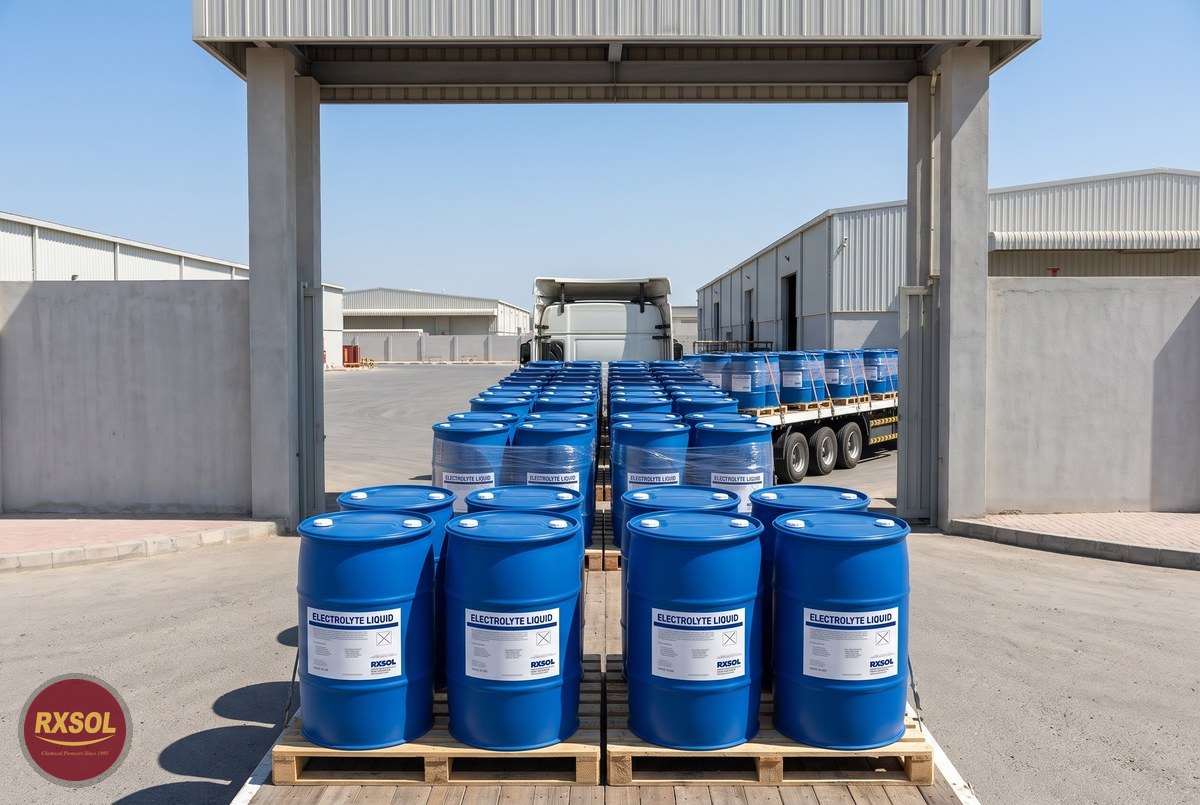
Before you fill or top up a battery on a vessel at Sohar port or in a plant battery room, check which electrolyte it takes. Battery electrolyte liquid in Oman is sold in two different chemistries. Nickel cadmium (Ni-Cd) batteries use an alkaline potassium hydroxide solution, and lead acid batteries, including dry charged lead acid units, use dilute sulfuric acid. Our Electrolyte Liquid (RXSOL-16-1024-025) is the alkaline type: a potassium hydroxide solution in distilled water suitable for nickel cadmium batteries. We deliver it from our Barka warehouse to Sohar and Al Batinah.
The rest of this page covers how to tell the two types apart, what our KOH electrolyte contains, how a dry charged lead acid battery is filled and commissioned, and how to order.
Two kinds of battery electrolyte and why they must never meet
Lead acid electrolyte is dilute sulfuric acid (H2SO4, CAS 7664-93-9) in deionised water. Ready-to-fill battery acid grades are typically about 35 to 38% w/w H2SO4. Ni-Cd batteries use an alkaline electrolyte, a potassium hydroxide solution with a typical density of about 1.20. The two must never be mixed, and one must never stand in for the other.
On ships and in Sohar Industrial Estate plants you will often find both: lead acid starter batteries on generators and vehicles, and Ni-Cd banks for emergency lighting, switchgear tripping or standby power. Label your filling equipment and storage shelves by chemistry. A jug or hydrometer that has held acid should never go into a Ni-Cd cell, and the reverse is also true.
If the battery label says Ni-Cd, nickel cadmium or alkaline, you need our Electrolyte Liquid. If it says lead acid, or the cells are sealed with transport plugs and marked dry charged, you need a sulfuric acid filling electrolyte. Send us the battery maker's sheet if you are unsure and we will tell you what we can supply.
Our KOH Electrolyte Liquid: specification
Our Electrolyte Liquid is a high-purity aqueous alkaline solution based on potassium hydroxide. It comes ready to use as a liquid, so your crew does not have to dissolve solid alkali on board or in the workshop. Density is held within 1.20 ± 0.05 for batch consistency, and the potassium hydroxide content supports ionic conductivity in suitable battery systems.
| Parameter | Specification |
|---|---|
| Part numbers | RXSOL-16-1024-025, RXSOL-25-1024-170 |
| Description | Potassium Hydroxide Solution in Distilled Water suitable for Nickel Cadmium Batteries |
| Application | Alkaline battery electrolyte systems, industrial battery service, electrochemical processes, controlled alkaline medium preparation, laboratory and technical uses where a specified concentration KOH solution is required |
| Appearance | Clear to slightly hazy liquid |
| Color | Colorless to pale yellow |
| Odor | Odorless |
| pH | Strongly alkaline |
| Potassium Hydroxide Content | 20 - 25% |
| Density at 25°C | 1.20 ± 0.05 g/cm³ |
| Solubility in Water | Completely miscible |
| Flammability | Non-flammable |
| Packing | Confirmed with your quote |
Final suitability should always be confirmed through customer-side testing under actual operating conditions. If your Ni-Cd cells come with a commissioning sheet from the cell maker, follow its fill level and first charge instructions.
Filling dry charged batteries: the lead acid procedure
Many buyers in Sohar search for electrolyte because they have a new dry charged battery to activate. Dry charged batteries leave the factory charged but without electrolyte. The negative plates are protected from oxidation and each cell is sealed with a transport cap during storage. These are lead acid batteries, so they are filled with sulfuric acid electrolyte, never with water and never with our alkaline KOH product.
The typical filling specific gravity for dry charged cells is about 1.28 kg/l at 30 °C, rising to a nominal 1.29 after the commissioning charge. Some manufacturers specify 1.260 ± 0.005 or 1.265 for filling, so always follow the battery maker's figure. For reference, typical electrolyte SG by battery class is about 1.265 for starter batteries, about 1.225 for stationary batteries and up to 1.330 for deep-cycle batteries.
The usual activation sequence is:
- Measure and record the acid temperature. The filling acid should be between 15 °C and 30 °C when poured.
- Remove the transport plugs and fill each cell to the anti-surge baffle or the top of the separators, using acid-resistant filling equipment.
- Let the battery stand while the plates and separators absorb the acid: typically 30 minutes for small batteries and up to 2 hours for traction cells. Electrolyte temperature rises and SG drops during this time.
- Top up with electrolyte to the correct level before charging.
- Give a full, uninterrupted first (commissioning) charge. Charging is complete when SG and cell voltages have not risen for 2 hours and all cells gas evenly.
For buyers checking acid quality, impurity limits for filling electrolyte and for top-up water in vented lead acid batteries are set by IEC 62877-1/-2, adopted in the GCC as GSO IEC 62877-1:2021 and GSO IEC 62877-2:2021. Chloride and iron damage the plates, so ask for a certificate of analysis with any battery acid you buy.
Sohar's summer heat, hydrometer readings and top-ups
Summer days in Sohar push battery rooms, deck stores and workshop floors well above the 30 °C upper limit for filling acid. Keep the electrolyte stock in a shaded, ventilated store and check its temperature before you pour. During the commissioning charge, stop charging if the electrolyte exceeds about 55 °C. Some makers set a lower 46 °C / 115 °F limit.
Heat also changes hydrometer readings. The temperature correction is typically about 0.0007 SG per °C (about 0.003 per 10 °F), and higher temperatures read lower. For example, 1.28 at 45 °C equals about 1.29 at 30 °C. Typical state of charge by SG at 25 °C is 1.265 to 1.275 for 100%, 1.225 to 1.235 for 75%, 1.190 to 1.200 for 50%, 1.155 to 1.165 for 25% and 1.120 to 1.130 when discharged.
After activation, top up a lead acid battery only with approved purified (deionised) water, never with acid. If the end-of-charge SG is too high, replace part of the electrolyte with purified water.
Who uses battery electrolyte in Sohar
Our Electrolyte Liquid suits Ni-Cd battery service on vessels at Sohar port, maintenance teams at the steel, aluminium, refinery and petrochemical plants in Sohar Industrial Estate, and electrical contractors who look after standby battery banks. It sits in our deck, cabin and galley maintenance chemicals, so you can ask us to add it to a wider stores order for the same vessel or site.
If your vessel calls at Muscat instead, the same product is listed on Muscat Chemical for Port Sultan Qaboos and Muscat deliveries. For ships working out of the south, it is also listed for Salalah port deliveries.
Safety, storage and handling
Both electrolytes burn skin and eyes. Eye splashes can cause permanent blindness, skin contact causes serious burns, and swallowing causes irreversible damage. Wear protective glasses and clothing when filling or topping up. No smoking, naked flames or sparks, because charging batteries release explosive gas. Wash acid splashes on the eyes or skin with plenty of water and see a doctor. Wash contaminated clothing in water. Keep an eye-wash bottle in the battery room, the engine room and the deck store.
For lead acid spills, neutralise spilled acid with a soda solution (about 1 kg soda per 10 L water, or 100 g bicarbonate per 1 L), then rinse and dry, and keep the neutraliser out of the cells. Soda neutralises acid only, so do not use it on a KOH spill. For our alkaline Electrolyte Liquid, treat it as strongly alkaline and corrosive, and contact us for handling information before use.
Battery acid travels as UN2796 'Battery fluid, acid', Class 8, Packing Group II, with the GHS hazard statements H290 and H314 and the signal word Danger. If you keep dry charged batteries in a coastal store, store them in a dry, cool place protected from wind, moisture and rain, with the caps kept on. Typical maximum storage before filling is about 2 years. Longer storage lets the negative plates oxidise and lengthens activation.
Ordering battery electrolyte liquid in Oman from Sohar Chemical
Sohar Chemical (RXSOL group, Oman) supplies Electrolyte Liquid from our Barka warehouse, with deliveries to Sohar and Al Batinah. Call +968 99489269 or message us on WhatsApp with the battery type, the number of cells and the quantity you need, and we will confirm packing and delivery. If you want to combine Electrolyte Liquid with other maintenance chemicals in one delivery, pick them from our full list of Sohar Chemical products and send us the list.
Request a quote on WhatsApp +968 99489269 or through our quote request page.
Frequently asked questions
What is the difference between acid electrolyte for lead acid batteries and alkaline electrolyte for Ni-Cd batteries?
Lead acid electrolyte is dilute sulfuric acid in deionised water, typically about 35 to 38% w/w H2SO4 for ready-to-fill grades. Ni-Cd electrolyte is an alkaline potassium hydroxide solution. Our Electrolyte Liquid is the alkaline type, with 20 - 25% potassium hydroxide and a density of 1.20 ± 0.05 g/cm³ at 25°C. Never mix them or use one in place of the other.
Can I fill a dry charged battery with water instead of electrolyte?
No. Dry charged lead acid batteries must be filled with electrolyte, not water, before use. After activation, top up only with purified (deionised) water, never with acid.
How long should a dry charged battery soak after filling before charging?
Typically 30 minutes for small batteries and up to 2 hours for traction cells. Electrolyte temperature rises and SG drops during this time, so top up with electrolyte to the correct level, then give a full, uninterrupted first charge.
How do I correct hydrometer readings for high temperatures in Oman?
The correction is typically about 0.0007 SG per °C, and higher temperatures read lower. For example, 1.28 at 45 °C equals about 1.29 at 30 °C. During charging, stop if the electrolyte exceeds about 55 °C, or the lower limit your battery maker sets.
Where can I buy battery electrolyte in Sohar or Muscat?
Sohar Chemical supplies Electrolyte Liquid for Ni-Cd batteries from our Barka warehouse with delivery to Sohar and Al Batinah. The same product is listed on Muscat Chemical for Muscat deliveries. Call or WhatsApp +968 99489269 for a quote.
