Closed Cooling Water Corrosion Inhibitor for Sohar Plants
November 01, 2026
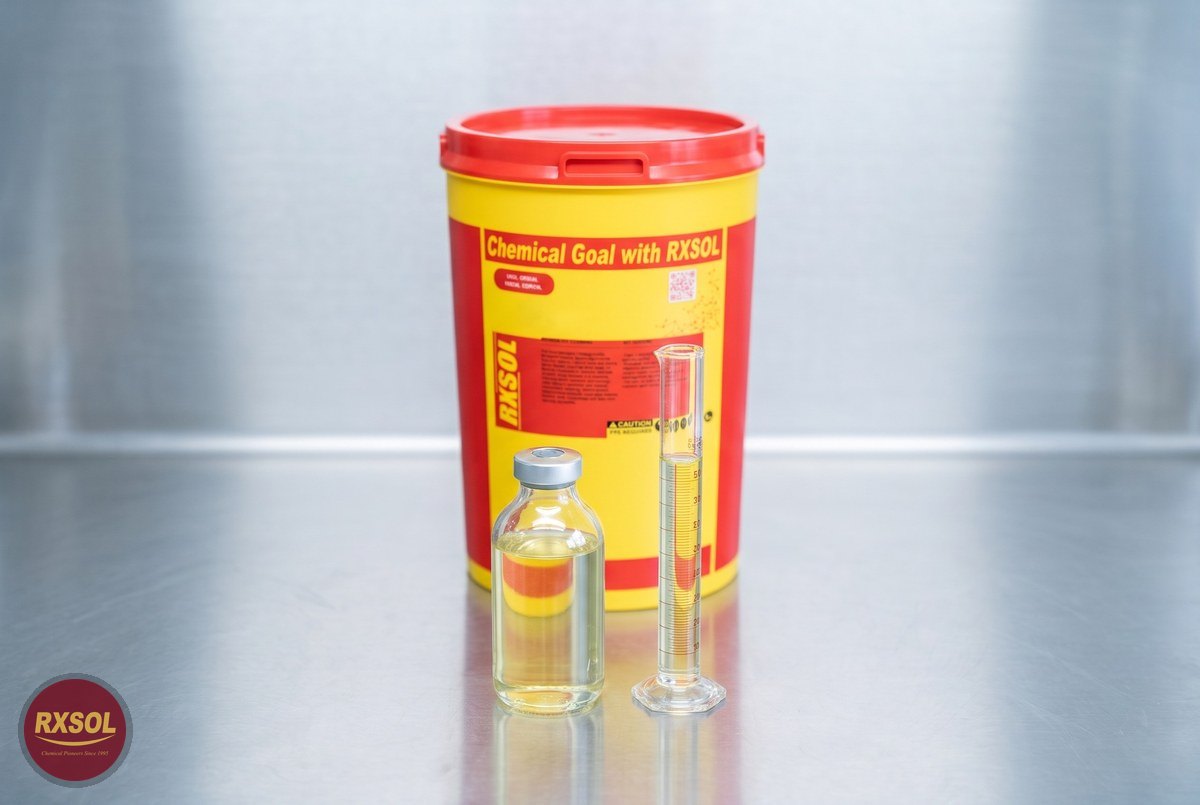
Closed loops at Sohar steel, aluminium and refinery plants still corrode, and we supply a molybdate phosphonate closed cooling water corrosion inhibitor for them from our Barka warehouse. Among the corrosion inhibitors for closed cooling water systems, our RXSOL-40-4018 blend protects steel, copper and copper alloys and keeps heat transfer surfaces clean. It is designed to hold steel corrosion at or below 0.125 mm/year. You keep 400 ppm to 1000 ppm of product in the loop water, check the residual and pH on a schedule, and top up as water is lost.
Why Closed Cooling Loops in Sohar Still Corrode
A closed loop loses little water. A tight system loses 5% or less of its volume per year, so it is easy to assume the loop needs no treatment. But the water still carries dissolved oxygen, and every top-up brings in more. Mixed metals in one circuit also set up galvanic cells between steel pipework and copper or brass exchanger tubes.
Heat makes it worse. Loops serving casting moulds, furnace panels and process exchangers run warm, and the Sohar summer pushes the whole loop hotter. Corrosion reactions run faster at higher temperatures, and any deposit on a hot surface becomes a site for under-deposit attack.
Leaks, stagnant legs and bacteria also use up inhibitor. A low or missing molybdate or orthophosphate residual is one of the first signs that the system needs repair or more inhibitor. The residual reading therefore tells you about the health of the loop as well as the level of the chemical.
What a Molybdate Phosphonate Corrosion Inhibitor Contains
Products of this class are water-based blends. A typical formula has these parts:
- sodium molybdate at about 15 to 22%
- a phosphonate at typically 5 to 10%
- tolyltriazole for copper alloys
- a polyacrylic dispersant
- an alkali such as potassium hydroxide at typically 1 to 5%
Our product record lists the active groups as a metal pretreatment filming agent, a film settlement agent, a surface activating agent, sodium molybdate and organophosphorus compounds.
Each part has a job. Molybdate passivates steel and protects well against chloride and sulfate. The phosphonate controls scale and supports the protective film. The azole protects copper and brass tubes, and azoles at 1 to 2 ppm may be enough to protect copper alloys. The dispersants stop calcium, silica, iron, sludge and organics from fouling the surfaces, which keeps heat transfer up. Our formula contains no chromate, zinc or heavy metals, and it protects against galvanic corrosion in mixed-metal systems.
| Item | Detail |
|---|---|
| Part numbers | RXSOL-40-4018-025, RXSOL-44-4018-250 |
| Product type | Molybdate-Phosphate for Closed Circulation Machinery Cooling Corrosion inhibitor |
| Application | Secondary cooling water in power plants, blast furnace cooling, mould cooling in continuous casting mills, hot and cold water systems in the chemical industry, industrial and HVAC closed loops |
| Dosage | Maintain 400 ppm to 1000 ppm of product in the system water; ca. 1500 ppm for systems with high water losses |
| Appearance | Clear Colourless to Pale Liquid (RXSOL-40-4018-025); Brown Coloured Hazy Liquid (RXSOL-44-4018-250) |
| Density | Typically 1.12 to 1.20 g/ml |
| pH | Typically about 12 as supplied, about 11 at 1% dilution |
| Flash point | None (non-flammable) |
| Boiling point | 100 °C |
| Solubility | 100% in water, mixes in any ratio |
| Performance targets | Corrosion rate ≤0.125 mm/year (steel); scale formation rate ≤0.2 mm/year |
| Packing | Confirmed with your quote |
Molybdate vs Nitrite: Which Closed Loop Inhibitor to Choose
Nitrite is the most common alternative. It runs at 500 to 1,500 ppm with pH 8.5 to 11, and if the residual falls too low, through-wall pitting can follow. Nitrite also feeds nitrifying bacteria, which is a common reason nitrite residuals drift down in warm loops.
Molybdate does not feed algae or bacteria. Its control range is roughly one third of the nitrite range. Our product notes state that sodium molybdate at levels of 50-100 ppm gives the same level of corrosion protection as sodium nitrite at levels of 800+ ppm. The lower dose keeps conductivity down, and lower conductivity reduces the risk of galvanic corrosion where steel and copper share the same loop.
Your nitrite loop may keep losing residual, show bacterial growth, or have copper and steel in the same circuit. In any of those cases, a molybdate corrosion inhibitor is the switch we would look at first. Send us your current test results and a list of the metals in the loop, and we will advise on the changeover.
Where It Is Used in Sohar Industrial Zone and Sohar Port
The product is designed for secondary cooling water in power plants, blast furnace cooling systems, mould cooling in continuous casting mills, and hot and cold water systems in the chemical industry. In Sohar, that covers:
- closed circuits on steel plant casting lines and furnaces
- hot and cold water systems at chemical and petrochemical plants
- secondary cooling loops at power plants
- industrial and HVAC closed loops in plant buildings
At Sohar port, the same chemistry suits closed machinery cooling circuits on vessels and port equipment. For diesel engine jacket water, ask us first. We also carry other cooling water treatments for engines, compressors, chillers and DG sets, and we will match the product to the engine maker's requirements. Ask us which of them suit your plant.
Closed System Corrosion Inhibitor Dosage, pH and Testing
You can add RXSOL-40-4018 neat or diluted, as it mixes with water in any ratio. The dose depends on how your system runs and how much water it loses. Systems should maintain 400 ppm to 1000 ppm of product in the water, while systems with high water losses should maintain ca. 1500 ppm. As a working figure, each cubic metre of loop water at 1000 ppm takes 1 kg of product, so measure or calculate your loop volume before the first charge.
Watch pH after dosing. The product is alkaline, and for carbon steel loops the target is pH 9.0 to 10.5. Sodium molybdate programmes typically run between pH 9.0 and 11.0, and pH above 12 can cause caustic embrittlement.
Make-up water matters in Oman. Many Sohar plants top up with desalinated or RO water, which is low in hardness. That suits this blend, which should be used with soft water to avoid calcium phosphate deposits when water losses are high. Soft, low-mineral water can attack bare steel, so bring the residual into range from the first fill. Molybdate works best with some dissolved oxygen present, but oxygen entering with make-up water still has to be controlled.
Closed cooling water monitoring
Check these on every test round:
- Inhibitor residual, with a molybdate test kit or UV-VIS
- pH and conductivity
- Total iron: a rising figure points to steel corrosion
- Bacteria, with dip slides or a bacteria test
- Corrosion coupons in a coupon rack, read at set intervals
If the residual falls and you have not drained any water, look for a leak, a stagnant section or bacterial growth. If bacteria show up, use a non-oxidizing biocide such as glutaraldehyde, isothiazolone, DBNPA or THPS, because oxidizing biocides are generally not used in closed systems. If copper levels in the water rise, the copper protection needs attention. Test and correct the inhibitor level before the exchanger tubes thin.
Where to Buy a Closed Cooling Water Corrosion Inhibitor in Sohar
Sohar Chemical (RXSOL group, Oman) supplies this product from our Barka warehouse, with deliveries to Sohar and Al Batinah. You will find details for each grade on the RXSOL-40-4018-025 molybdate phosphonate inhibitor page and the RXSOL-44-4018-250 grade page. If you run loops in both cities, the same product is also listed on our Muscat Chemical site for plants in Muscat and Rusayl.
Tell us your loop volume, the metals in the loop and your current water results. We will then confirm the grade, pack size and quantity for the first charge and for top-ups.
Store the product indoors and protect it from freezing. Typical shelf life is about 2 years. The product is irritating to eyes and skin (Xi, R36/38): use proper chemical protective hand gloves and eye goggles, and wear overalls. Absorb spills with inert material and flush the area with water.
Call +968 99489269, email muscatchem@gmail.com or use our Sohar Chemical quote request form.
Frequently Asked Questions
Is molybdate or nitrite better for closed loop systems?
Both work when the residual stays in range. Molybdate does not feed bacteria, and its control range is roughly one third of nitrite's. It also keeps conductivity lower, which helps loops with mixed metals. Nitrite runs at 500 to 1,500 ppm and can cause through-wall pitting if the residual falls too low.
How much molybdate should be kept in a closed cooling loop?
For our product, maintain 400 ppm to 1000 ppm of product in the water, or ca. 1500 ppm where water losses are high. For molybdate inhibitors in general, a common sodium molybdate dosage range is 200 to 1,000 ppm. Ask us for the test kit reading that matches your product dose.
What pH should a closed cooling water system run at?
For carbon steel loops, keep pH at 9.0 to 10.5. Molybdate programmes typically run at pH 9.0 to 11.0. Avoid pH above 12, which can cause caustic embrittlement.
Does a molybdate inhibitor protect copper and brass heat exchangers?
Yes. Our blend contains inhibitors for steel, copper and copper alloys and protects against galvanic corrosion in mixed-metal systems. Products of this type protect the copper parts with an azole such as tolyltriazole.
Is a molybdate-based inhibitor safe to discharge with bleed-off?
Formulas of this class contain no heavy metals or chromates and are described as safe to discharge with bleed-off at normal use rates. Before you drain a full loop, check the discharge conditions in your plant's environmental permit.
Request a quote for your closed cooling water corrosion inhibitor on WhatsApp at +968 99489269, and we will reply with the grade, packing and delivery to your Sohar site.
Frequently asked questions
Is molybdate or nitrite better for closed loop systems?
Both work when the residual stays in range. Molybdate does not feed bacteria, and its control range is roughly one third of nitrite's. It also keeps conductivity lower, which helps loops with mixed metals. Nitrite runs at 500 to 1,500 ppm and can cause through-wall pitting if the residual falls too low.
How much molybdate should be kept in a closed cooling loop?
For our product, maintain 400 ppm to 1000 ppm of product in the water, or ca. 1500 ppm where water losses are high. For molybdate inhibitors in general, a common sodium molybdate dosage range is 200 to 1,000 ppm. Ask us for the test kit reading that matches your product dose.
What pH should a closed cooling water system run at?
For carbon steel loops, keep pH at 9.0 to 10.5. Molybdate programmes typically run at pH 9.0 to 11.0. Avoid pH above 12, which can cause caustic embrittlement.
Does a molybdate inhibitor protect copper and brass heat exchangers?
Yes. Our blend contains inhibitors for steel, copper and copper alloys and protects against galvanic corrosion in mixed-metal systems. Products of this type protect the copper parts with an azole such as tolyltriazole.
Is a molybdate-based inhibitor safe to discharge with bleed-off?
Formulas of this class contain no heavy metals or chromates and are described as safe to discharge with bleed-off at normal use rates. Before you drain a full loop, check the discharge conditions in your plant's environmental permit.
